If you've been half-listening to Fort Myers Beach news since December, you've probably absorbed the headline in one sentence: the town got its flood insurance discount back. Twenty-five percent off, starting April 1, 2026. Town Manager Will McKannay called it a "gold standard for a barrier island" when Fox4Now covered the announcement, and residents who'd been paying full freight since 2024 finally had something to celebrate.
Here's the part the headline skips. That 25 percent doesn't land the same way on every parcel on Estero Island. The same federal rule that got the whole town put on probation in the first place is the exact rule that now decides which individual houses actually feel this relief and which ones are still carrying the older, uncompliant math that caused the problem. If you're comparing Fort Myers Beach against other Gulf Coast towns right now, the town-wide rating tells you less than the elevation certificate on the specific listing you're looking at.
What Actually Happened in December
Fort Myers Beach earned back a Class 5 rating in FEMA's Community Rating System in December 2025, one month after the town came off National Flood Insurance Program probation entirely. The WGCU News coverage of the announcement quoted McKannay calling it "a game-changing win," and the practical effect is straightforward: most property owners insured through the NFIP became eligible for a 25 percent reduction in flood insurance premiums on policies issued or renewed on or after April 1, 2026. That date has already passed. If you're shopping for a home on the island today, the discount is live, not pending.
FEMA also confirmed the rating renews automatically each year as long as the town stays in good standing, which is worth knowing if you're the kind of buyer who wants to understand whether a benefit is durable or a one-time bump.
How the Whole Island Lost It in the First Place
To understand why this discount is uneven, you need the two years that preceded it.
Hurricane Ian hit Fort Myers Beach directly in September 2022. In the scramble to rebuild, permits went out fast, temporary structures went up everywhere, and normal floodplain review got harder to keep straight. By 2024, FEMA had found enough of a pattern that it acted. In April of that year, federal regulators told Lee County and four municipalities, including Fort Myers Beach, that residents were losing their flood insurance discounts because rebuilds weren't following the agency's rules. WUSF's reporting at the time noted the rollback affected more than 115,000 flood insurance policyholders across Lee County, Cape Coral, Fort Myers Beach, Estero, and Bonita Springs, with the average policyholder seeing a $300 annual increase starting that October.
The mechanism behind the rollback matters more than the headline number. FEMA's issue wasn't hurricane damage itself. It was that more than 600 Lee County homeowners had renovated or rebuilt in ways that violated the federal 50 percent rule, the same rule that governs every substantial improvement on the island today. The town's CRS class dropped straight to the bottom, a Class 10 with a 0 percent discount, and Fort Myers Beach was placed on formal NFIP probation, which added a $50 surcharge to every federal flood insurance policy in the community regardless of whether that individual property had done anything wrong.
What It Took to Earn It Back
Getting off probation wasn't a paperwork exercise. FEMA identified 252 specific properties that needed remediation, along with temporary structures that had to come down and permitting processes that had to be rebuilt from the ground up. Rather than let departments work in isolation, the town created a cross-department compliance team that met twice a week to review problem properties one at a time. McKannay and Deputy Town Manager Traci Kohler described the shift in a case study for ICMA's PM Magazine: instead of asking what each department had done, the meetings asked what a given property still needed and who owned the next step.
"A Class 5 CRS rating means lower flood insurance costs for our residents, stronger protection for homes and businesses, and national recognition that this Town has turned a corner."
That's McKannay's framing of the win, and it's an accurate one at the town level. Probation lifted in November 2025. The Class 5 designation followed a month later. But the compliance work that earned back the discount is the same 50 percent rule that still governs every renovation decision on the island going forward, for buyers, sellers, and anyone weighing a remodel.
The Timeline, in One Place
| Date | Event |
|---|---|
| September 2022 | Hurricane Ian makes landfall, direct hit on Fort Myers Beach |
| April 2024 | FEMA notifies Lee County and Fort Myers Beach of discount rollback |
| October 2024 | Rollback takes effect; CRS discount drops to 0 percent, $50 probation surcharge added |
| November 2025 | FEMA lifts NFIP probation |
| December 2025 | FEMA and DHS confirm Class 5 CRS rating |
| April 1, 2026 | 25 percent discount takes effect on new and renewed policies |
The Rule That Never Left the Island
The 50 percent rule, which the town's own floodplain management page lays out plainly, states that repairs or improvements on a structure exceeding 50 percent of its market value trigger full compliance with current floodplain regulations. That means elevation to base flood elevation, plus the town's freeboard requirement, and it applies whether the trigger came from storm damage or from a voluntary renovation. A kitchen remodel and a hurricane can land you in the same compliance bucket if the dollar figure crosses that line.
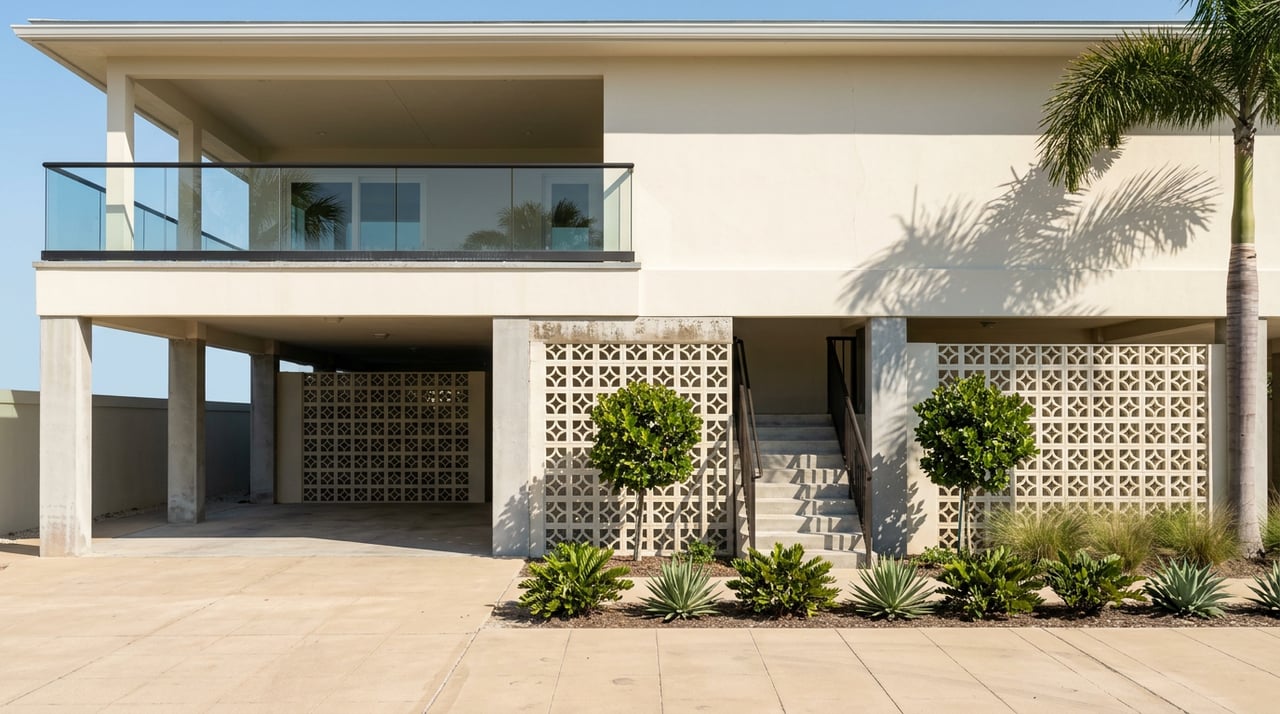
This is the detail that separates a house that benefits fully from the new discount from one that doesn't. A home elevated to current code after Ian, with a documented compliance history, is exactly the kind of structure the CRS rating rewards. A home that never crossed the 50 percent threshold, and so was never required to elevate, is still insured at whatever baseline rate its flood zone and construction type produce, discount applied on top of that baseline. The 25 percent is real. What it's 25 percent of depends entirely on the house.
Why the Same Percentage Means Different Money
Flood insurance quotes on Southwest Florida's barrier islands have varied widely depending on elevation, construction age, and flood zone designation, with one insurance industry estimate for 2026 putting island premiums in the mid-$7,000 to high-$8,000 range against a roughly $7,000 baseline, well above the mainland non-beachfront average. A 25 percent discount on a lower baseline premium is a meaningful but modest annual savings. The same 25 percent on a premium that was already elevated because of non-compliance or an unfavorable flood zone is a much bigger number, but it's a discount applied to a cost that was higher to begin with. Neither scenario tells you what your specific offer should look like. Only the individual property's elevation certificate and permit history does that.
This is also where flood zone designation does real work. The town's own flood maps split the island between VE zones, the more restrictive coastal high-hazard designation for areas exposed to wave action, and AE zones elsewhere on the island. A structure's zone designation, not just its CRS-wide discount, shapes the base premium the 25 percent gets applied against.
What to Ask Before You Write an Offer
If you're comparing a Fort Myers Beach listing against a home in Bonita Springs or Naples right now, the CRS discount is a real point in the island's favor, but it's not a substitute for property-level diligence. Before you get attached to a number a listing agent or seller quotes you, ask for:
- The property's current elevation certificate, and whether the lowest floor sits at or above base flood elevation
- Whether the home has an active NFIP policy already reflecting the post-April 2026 discount, or whether the current owner's policy predates it
- Any substantial improvement or substantial damage determination on file with the town, and what work triggered it
- Whether the property was among the 252 flagged during the town's compliance push, and if so, what remediation was completed
None of this requires adversarial digging. Fort Myers Beach's Community Development Department fields these requests regularly, and a seller with a clean compliance history usually has the paperwork ready. The point isn't suspicion. It's making sure you're pricing the house in front of you rather than the headline about the island.
Questions Buyers Keep Asking
Does the 25 percent discount apply to condos as well as single-family homes? The CRS discount applies at the community level to NFIP policies generally, which includes condominium flood policies, though the underlying premium a condo association or unit owner pays still depends on the building's elevation and flood zone.
Is the Class 5 rating permanent? FEMA has confirmed it renews automatically each year as long as the town remains in good standing with the National Flood Insurance Program and continues the certified activities that earned the rating.
What if a home was never flagged and never elevated? It can still be perfectly insurable and may carry a lower baseline premium precisely because it never triggered the 50 percent rule. The discount still applies. The question is simply what it's a discount from.
Fort Myers Beach's insurance story in 2026 is a genuine recovery, but it's a recovery that rewards documentation over assumption. If you're weighing a purchase on the island, or you own a place there and are wondering what a remodel would actually trigger under the rule that shaped all of this, Michael Kussmann has spent 17 years on the construction and renovation side of these decisions before ever writing an offer. Let's start your move. Get a free home valuation or call Mike today.


