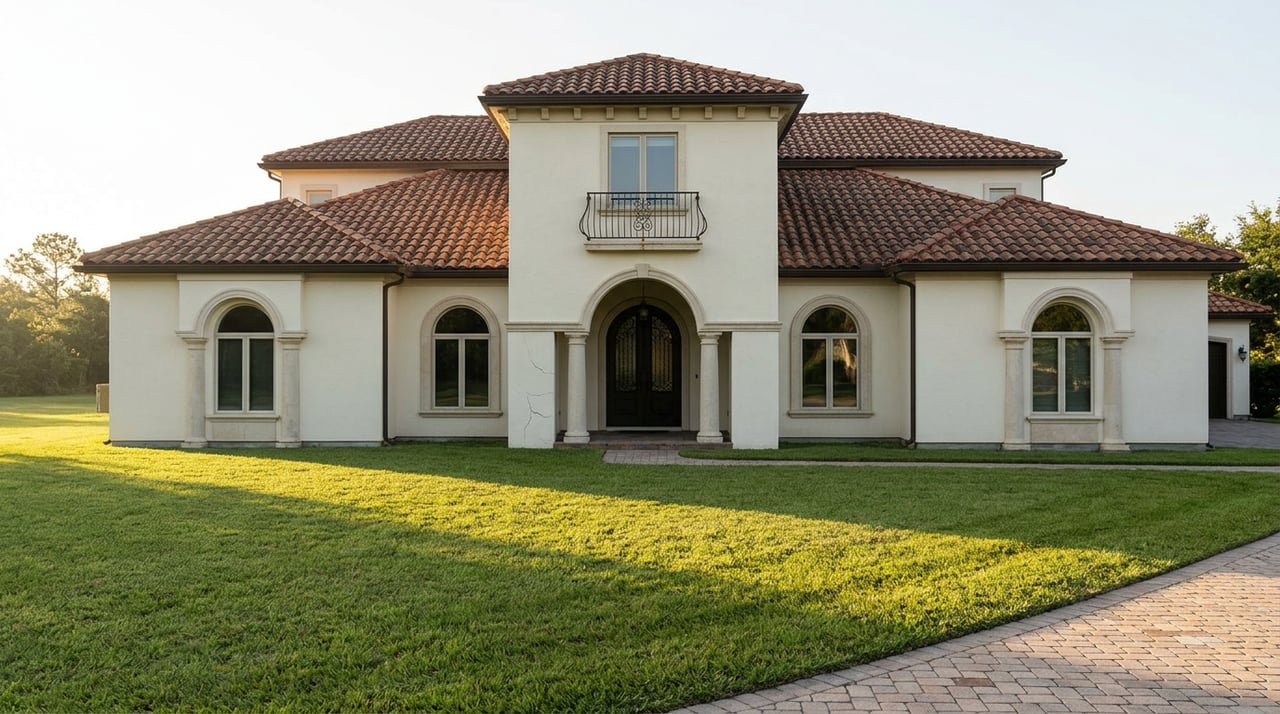
Why do two listings that both say "Golden Gate, Naples" sit tens of thousands of dollars apart on price and behave like completely different assets? The answer isn't confusing pricing. It's that Golden Gate isn't one market. It's two, split down the middle by Collier Boulevard, and the line between them changes what you're actually buying: a house priced by the square foot, or an acre priced by how much of it you're legally allowed to build on.
That second half is the part most comparisons skip. Golden Gate City and Golden Gate Estates get compared on lot size and HOA fees all the time. What rarely gets explained is that acreage on paper and acreage you can build on are not the same number, and the gap between them is where a lot of Estates deals get renegotiated after inspection.
One Address, Two Ledgers
Golden Gate City sits west of Collier Boulevard. It was platted in the 1960s as a conventional urban grid, with public water and sewer already run to the street. As of June 2026, single-family homes there were largely trading between $400,000 and $550,000, valued the way most Naples neighborhoods are valued: price per square foot.
Golden Gate Estates starts east of Collier Boulevard and keeps going. It's the largest platted subdivision in the country, built on lots that run from 1.14 acres up to 10 acres, most of them roughly 660 feet deep. There's no HOA, no public sewer, and no shared valuation logic with the City side. As of the same June 2026 window, improved homes in the Estates ranged from about $375,000 to well over $600,000, but the metric that actually moves that number isn't square footage. It's price per acre, and price per acre only tells you the truth if you already know how much of that acre is usable.
| Golden Gate City | Golden Gate Estates | |
|---|---|---|
| Platted | 1960s urban grid | Largest platted subdivision in the U.S. |
| Location | West of Collier Boulevard | East of Collier Boulevard |
| Lot size | Standard suburban lots | 1.14 to 10 acres |
| Utilities | Public water and sewer | Private well and septic |
| HOA | None reported in typical listings | None |
| Valuation metric | Price per square foot | Price per acre (usable) |
| Price band, June 2026 | $400,000 to $550,000 | $375,000 to $600,000+ |
Two markets, same street name, different math. If you're comparing a Golden Gate City listing to a Golden Gate Estates listing on a per-square-foot basis, you're not comparing apples to oranges. You're comparing a fruit to a farm.
The Acre You Can't Build On
Here's the part that catches Estates buyers off guard during due diligence, and it's the reason two five-acre lots can carry the same asking price and produce wildly different homes.
Collier County requires a 25-foot setback from any wetland boundary on a parcel. Side setbacks work differently depending on lot width: on lots under roughly 1.6 acres, the side setback is calculated as 10 percent of the lot's width. A typical 1.14-acre lot that runs about 75 feet wide ends up with side setbacks of roughly 7.5 feet on each side. Do that math on a lot with a wetland pocket cutting through the middle, and the buildable envelope can shrink dramatically compared to a same-sized lot that's 100 percent uplands.
This is why acreage near the edges of Picayune Strand State Forest, Belle Meade, or CREW Bird Rookery Swamp tends to carry more wetland exposure than parcels closer to the paved core of Golden Gate Boulevard. A lot advertised at 2.5 acres near one of those preserves might have a meaningfully smaller footprint once setbacks and wetland lines are drawn, while a 2.5-acre lot a mile away, fully upland, could support a much larger home and pool package. The acreage number on the listing sheet doesn't distinguish between the two. A wetland determination and a survey do.
If you're evaluating Estates land, the acreage figure is the starting point, not the answer. The buildable envelope is the answer, and it's worth confirming before you get attached to a floor plan.
What "No HOA" Actually Costs
The pitch for Golden Gate Estates almost always includes "no HOA, no monthly fees." All true. What that framing leaves out is that the absence of an HOA doesn't mean the absence of carrying costs. It means those costs move somewhere else.
Every Estates home runs on a private well and septic system, and maintaining both typically adds somewhere between $500 and $1,500 a year in upkeep, on top of periodic inspections and eventual repairs. That's not a deal breaker. It's a cost that a Golden Gate City buyer, hooked to public water and sewer, simply doesn't carry. When you're comparing monthly cost of ownership across the two halves of Golden Gate, the missing HOA line item on the Estates side is partially offset by a utility maintenance line item that never shows up on a listing sheet.
The other piece: while major corridors like Golden Gate Boulevard and Everglades Boulevard are county-maintained, many of the interior residential streets in the Estates are privately maintained, some of them gravel or shell rock, and they can get difficult to navigate during heavy rain. That can be a recurring inconvenience during Southwest Florida's wet season, and it's worth asking about before closing rather than after the first summer storm.
None of this makes Estates ownership a bad trade. It makes "no HOA" an incomplete sentence. The full sentence is: no HOA, and here's what replaces it.
The Financing Split Nobody Advertises
There's one advantage buried in the Estates side of this comparison that doesn't get much attention: because large portions of Golden Gate Estates are classified as rural, many addresses there currently qualify for USDA Rural Development loan programs, which can offer no-down-payment financing in eligible areas. That program isn't available on the Golden Gate City side, where zoning and density disqualify it. Eligibility is address-specific, not blanket across the entire Estates, so it's worth checking a property against current USDA maps before assuming it qualifies.
Raw, unimproved land in the Estates plays by different rules entirely. Vacant acreage typically requires 25 to 35 percent down and comes with shorter loan terms than a conventional mortgage on an improved home. That combination, cheap entry price per acre but a steep down payment requirement, is part of why Estates land tends to attract buyers with a five-to-ten-year horizon rather than someone trying to close with minimal cash up front.
Put those two financing realities next to each other and you get a genuinely odd local dynamic: an improved Estates home might be easier to finance with little money down than the empty lot next to it.
Before You Write the Offer
If you're looking seriously at either side of Golden Gate, a few questions are worth settling before you get to the negotiating table.
- Ask for the wetland determination on any Estates lot, not just the total acreage. A 2026 upland determination on a comparable nearby parcel is a useful benchmark for what "clean" acreage looks like in that immediate area.
- Confirm whether the street is county-maintained or privately maintained, and if private, ask what the current maintenance arrangement actually looks like.
- Get a septic and well inspection quote before you're under contract, not after, so the $500 to $1,500 annual upkeep estimate has real numbers behind it for that specific property.
- If financing is tight, check the exact address against current USDA Rural Development eligibility maps rather than assuming the whole Estates area qualifies.
- On the Golden Gate City side, confirm the listing's price-per-square-foot position against recent closed sales in that specific block, since the grid layout means comparables are usually close by and easy to pull.
A Couple of Questions Worth Answering Directly
Is Golden Gate Estates part of Golden Gate City? No. They're adjacent but separate markets with different platting histories, different utilities, and different valuation logic. Sharing the Golden Gate name is largely a historical artifact of how the area was originally developed.
Does every Golden Gate Estates lot qualify for USDA financing? No. Eligibility depends on the specific address and current USDA rural designation maps, not on being generally located in the Estates. Always verify the exact parcel with a lender before counting on the program.
If you're weighing a move into either half of Golden Gate, the numbers on the listing page are a starting point, not the full picture. Figuring out what's actually buildable, what utilities really cost over time, and which financing programs apply to a specific address is where the real decision gets made. That's the kind of groundwork Mike Kussmann walks clients through before an offer goes in, not after. Reach out for a straight read on a specific Golden Gate property, or start with a free home valuation if you're on the other side of this and wondering what your acreage or your square footage is actually worth right now.
This article is general information, not legal, tax or financial advice. Consult a qualified professional about your situation.